As winter wanes, Minnesota gardeners begin to ponder their favorite seeds and map out their dreams for spring planting and the summer harvest. Seeds hold memory and heritage. They hold the skill of the planter; they hold the knowledge of place and time.
In the early 19th century, enslaved women comprised part of an early African American community located above the junction of the Mississippi and Minnesota Rivers, at Fort Snelling. Against their will, these women were forcibly brought from West Africa to the southern United States then transported up the Mississippi River through St. Louis, by army officers. To counter displacement, they brought seeds from home, often discretely tucked into a hair braid or hidden in a secret pocket.
For enslaved women, kitchen gardens symbolized both remembrance and resistance. The simple act of planting a seed – to grow into a spicy pepper or a leafy green – was a way to maintain identity. Planting seeds was a means of survival in a harsh northern climate, both physically and metaphorically. While we may not know the specifics of each garden, we do know that fresh garden foods supplemented the preserved food that the army imported at Fort Snelling, largely salted pork and dried beans. As cooks, enslaved women incorporated their own food traditions, adding spices and techniques to Euro-American preferences that resulted in a blended culinary mix, laying the foundation for the traditional African American foods and culinary practices that exist today.
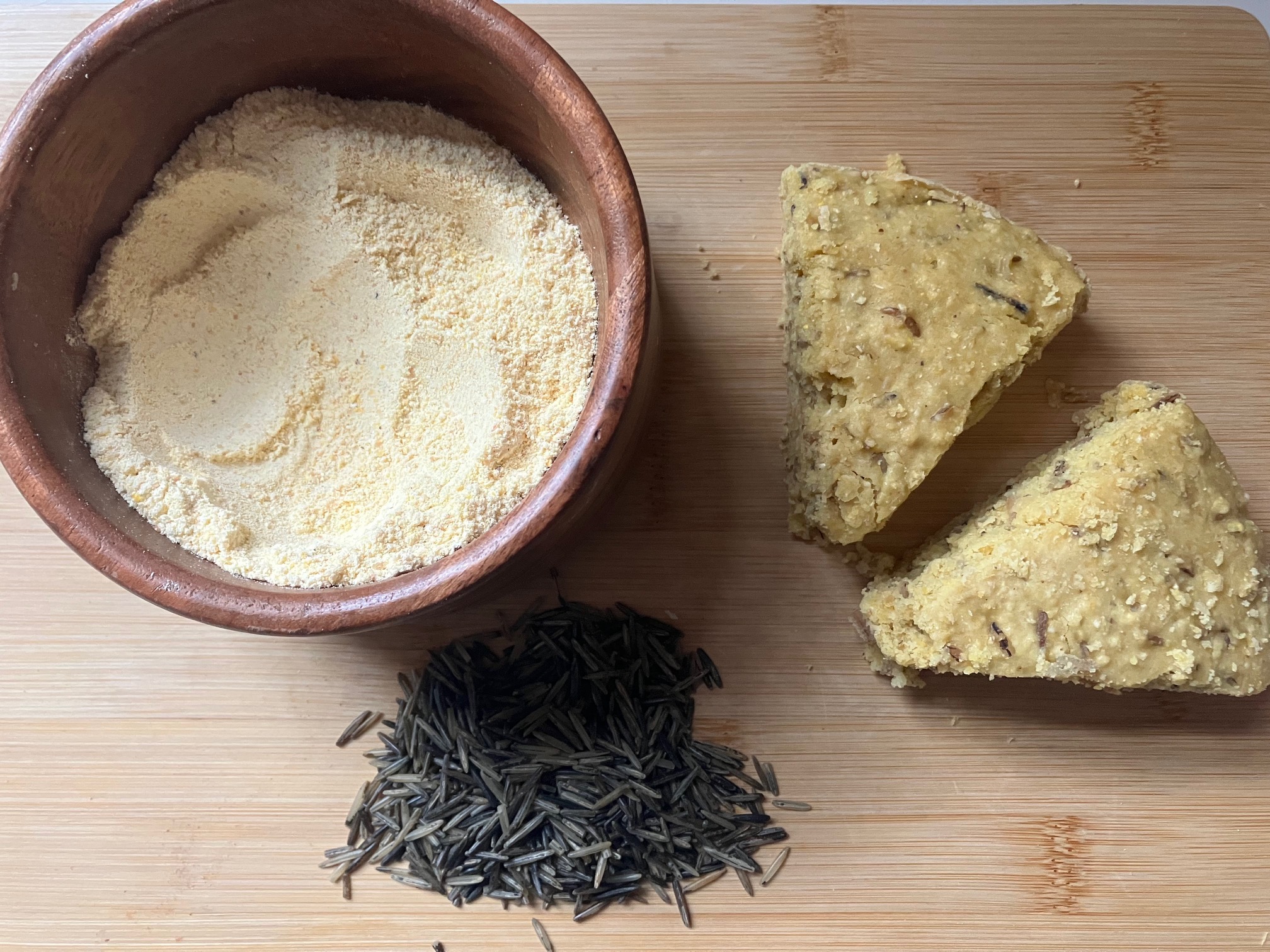
Image: Cornmeal and wild rice.
Any discussion of African American food history, regardless of place, always begins with a cook’s knowledge of traditional African foods: millet, sorghum, greens, red rice, hibiscus, spicy peppers, and true yams. If these foods were not readily available in the North, universally, cooks would substitute for foods that could be grown, foraged, or traded: wild rice, wild sweet potatoes, prairie turnips, cranberries, squash, beans, local greens, and roots. Maize, a food not indigenous to Africa but long grown there, was available for northerners through trading for seeds with Native Americans. This became a staple food that stored well and lent itself to a variety of cooking techniques, like boiling, baking, and roasting. Wild rice might serve as a substitute in an English pudding; similarly, cranberries could flavor a hibiscus tea. Maize was ground for bread baking when supplies of wheat ran low.
Much is missing from the written and oral record about early African American food culture and these gardeners and cooks at Fort Snelling. However, occasionally a detail lends insight into their lives. A seed of Rachel’s life shows up in the court record when she won her freedom suit. A seed of Jane’s life, described as an “excellent cook”, appears in the estate records of her enslaver: Zachary Taylor, former commander at Fort Snelling and 12th president of the United States. For others, it is important to remember their names, the only written detail of their life that remains: Mary, Louisa, Courtney, Araminta, Lavinia, Nancy, Jenny, Anne, Margaret. The seeds of these women’s lives shaped the beginning of African American food history in a place that would later become known as Minnesota.
*Our research is made possible in part by the people of Minnesota through a grant funded by an appropriation to the Minnesota Historical Society from the Minnesota Arts and Cultural Heritage Fund.
Midwest Food Connection teaches food education in classrooms across the Twin Cities and beyond. We help students build relationships with their food, and understand how their food choices connect to their environment and community. Through exploring new foods, healthy cooking, and gardening, kids get excited about learning how to nurture their bodies and the environment.
Want to bring MFC to your classroom? Sign up for lessons or follow us on social media to keep up with what we’re up to!
Thank you to our major sponsors